Why electricity pylons in Essex are the front line in the battle to hit net zero | Business News

Reliable. Secure. Since 2012. Exchange Crypto Sign up to get a trading fee discount!
[ad_1]
In the narrow lanes around Aldham in Essex the countryside is close to the English ideal.
On an unseasonably warm mid-October day the fields recede to a low horizon, broken only by hedgerows and the spire of the parish church, the tallest landmark this side of Suffolk.
If National Grid has its way it won’t stay that way for long.
Aldham is on the route of a new pylon line that will run more than 110 miles, from Norwich to Tilbury on the Thames Estuary, carrying electricity generated on wind farms in the North Sea via high voltage cables suspended from 50-metre tall towers.
National Grid, the listed company that owns and runs the UK’s electricity network, says it’s crucial to a massive grid upgrade without which the transition from fossil fuels to low carbon power cannot happen.
Read more
‘Milestone moment’ for electricity grid as new rules mean ‘zombie’ projects can be terminated
Britons paying hundreds of millions to turn off wind turbines as network can’t handle the power they make on the windiest days
For locals and campaigners it’s an unnecessary intrusion that will bring steel giants marching through some of the most scenic countryside in the east of England.
This is more than just a local planning dispute.
It’s a story about the most important national infrastructure project you have probably never heard of; about a glacial planning system that fails communities and builders; and the balance between local and national interests as the UK strives to hit its climate goals.
The great grid upgrade
On the road to net zero Britain is like a traveller who remembered their laptop and adapter but forgot to pack the plug cable.
For years we have been preparing for a low-carbon future by focusing on supply and demand, without thinking enough about the bit in between.
While supply has focused on phasing out fossil fuels, chiefly using offshore wind power, consumer and business demand has begun shifting to lower carbon options like electric vehicles and heat pumps.
This has transformed not just where we get our power, but how much we will need.
Demand for electricity will double in the coming decade as natural gas, petrol and diesel are phased out and a world reliant on digital data consumes vastly more power.
The expansion of offshore wind and, in time, nuclear, will meet demand, but those new power sources need to be connected to a grid originally built for the fossil fuel age.
The bones of the national grid were built in the 1960s and 70s, connecting power stations largely clustered around the coalfields of the north and midlands to cities and towns using ‘motorways’ of high-voltage pylons.
With most of our power coming from the coast in the future that has to change.
National Grid has identified 17 new or upgraded lines required, including undersea cables to link Scotland and the east of England and several onshore pylon routes, the largest of which is Norwich-Tilbury.
It will cost up to £19bn and most of it has to happen in seven years to meet the government’s target of decarbonising the grid by 2030.

Carl Trowell, President of strategic infrastructure at the National Grid
“There’s no energy transition without a massive upgrade to the transmission system. It’s an enabler for everything we want to do,” said the man in charge of delivering it, Carl Trowell, National Grid’s president of strategic infrastructure.
“Over the next seven to eight years we’ve got to build five times more infrastructure than has been built in the last 30, so it’s quite an upgrade.”
Fight the power
For Adam Scott, owner of Church House Farm in Aldham, the great grid upgrade means three 50-metre pylons planted on his land, and £6,000 each in compensation.
“You would happily pay £6,000 not to have them,” he said.
“There are many impacts. You’ve got to go round them with machines, you can’t irrigate land near them, if we want to grow trees to help climate change we wouldn’t be allowed to, so there’s a lot of separate impacts the pylons will have if they arrive in our village.”

Sky’s Business correspondent, Paul Kelso with farmer Adam Scott in East Anglia
Mr Scott and residents along the entire route have been galvanised by perhaps the most effective local campaign group in the country, the Community Planning Alliance, founded and run by Rosie Pearson.
Dubbed the “Queen of the Nimbys”, a term she loathes, Ms Pearson has been hugely successful in helping community groups maximise their influence to oppose infrastructure projects, primarily housing.
She believes the pylons are unnecessary and should go under the sea, referring to rough drawings of an alternative offshore plan she says would be cheaper.
“We don’t see why the pylons should be built across East Anglia when the wind farms are offshore and the power is needed down south. It’s offshore, keep it offshore,” she said.
National Grid utterly rejects this, saying campaigners have misrepresented their figures and insisting an offshore route would cost £4bn as opposed to £1bn for the pylons, with consumers ultimately paying the difference.
“The first thing to say is that Norwich to Tilbury is part of a wider system, some of which is offshore and some onshore. Going offshore is four to five times more expensive, and it comes with its own environmental issues,” said Mr Trowell.
“And you can’t put all your infrastructure offshore. It takes hours to repair a pylon but it can take months to years to try and fix a problem or a fault offshore. Ultimately we have to strike a balance, and that’s what we’ve done.”
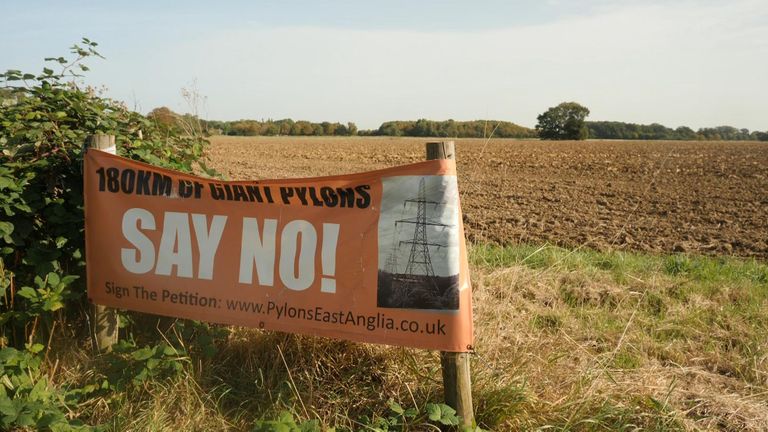
Local campaign groups oppose National Grid’s Norwich to Tilbury proposals
If the pylons are built, Ms Pearson says communities should be compensated for hosting in the same way as if Norwich to TIlbury was a train line.
Currently the grid, and the government’s electricity commissioner have said only that they should receive “benefits” from hosting infrastructure, such as cheaper bills.
“That’s patronising,” she said. “Full compensation needs to be paid to any farmer that’s having his business disrupted, any homeowner who can’t sell, any business that can’t run in the same way, not sweeteners.”
Planning problems
Where she and the grid agree is that the planning system is not working.
It can take a decade for major projects to pass through a system ill-designed to cope with the net zero infrastructure boom.
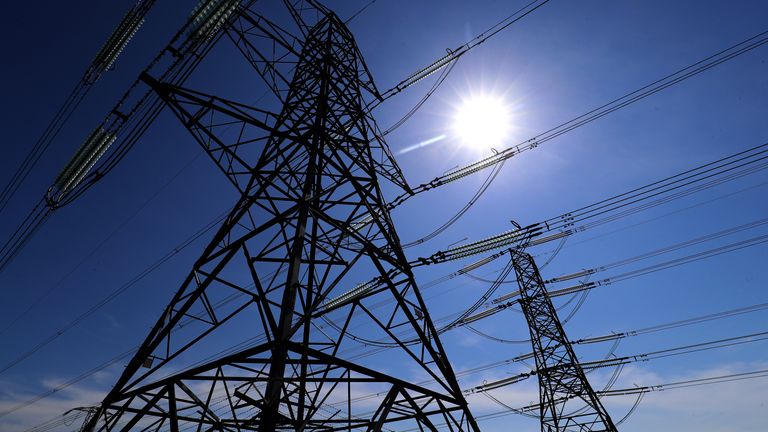
De-carbonising Britain’s electricity grid
Rosie Pearson may have helped around 600 local groups challenge various building projects, but she rejects the accusation that they stand in the way of progress.
“I think people look at it the wrong way.
“The system creates the objector, the planning system even calls us ‘objectors’. If the system involved communities right from the beginning, presented them with options or alternatives, with facts and pros and cons, then you’d end up with decisions being made much faster.
“I can certainly say with this pylons campaign, if we’d all been consulted at the beginning we’d probably be working towards a better solution for everybody.”
For National Grid and other infrastructure developers the problem is a lack of clarity. Major planning decisions are guided by National Policy Statements, many of which are out of date and leave many decisions open to interpretation.
Sir John Armitt, chair of the National Infrastructure Committee and the government’s senior adviser, told Sky News they need urgent rewriting and regular updating.
“The process gets bogged down partly because there isn’t clarity of direction from the outset that enables an inspector to judge a project against the importance of the project to the nation, much more than to a locality,” he said.
“What we have to do over the next 20 years does require boldness, it requires clarity, it requires a sense of leadership and a sense that this is very important for our country in terms of the economy, our ability to grow jobs to spread that wealth around the country, our ability to compete.
“If we don’t make the changes to our infrastructure that’s necessary, we risk being left behind.”
Source link
#electricity #pylons #Essex #front #line #battle #hit #net #Business #News Report Story



Popular Stories
-

Application Modernization Services & Solutions ctg.com
-

Better Home India betterhomeindia.com
-

Begum Pret – Designer Indian Ethnic Wear & Festive Fashion begumpret.com
-
B.Arch Course Details, Duration, Syllabus & Eligibility kolkata.amity.edu
-
How to Style Jewellery With Saree: Easy Tips for Every Outfit keshavjewellers.co.in
-
White Blood Cells: Understanding the Body’s Defense System hematologybmt.com
-
Branding Agency in Bangalore exalttechsoft.com
-
Memory Care San Diego, CA | Bayshire Torrey Pines bayshiretorreypines.com
-
Make Your Chicago Trip More Convenient chitownblackcars.com
-
The Surprising Importance Of Automatic Swing Gates In Urban Living theeliteautomaticdoors.com